
Why FRP poles are gaining ground
In aggressive atmospheres, high humidity or hard-to-access locations, composite poles offer an alternative to concrete and timber. The decision should look beyond purchase price: transport, installation crews, maintenance and service life all contribute to total cost.
Logistics and installation
The lower weight of FRP can increase units per shipment and simplify handling in remote areas. Depending on the design and field conditions, installation may require a smaller crew and less heavy equipment.
Durability and maintenance
The polymer matrix and glass-fiber reinforcement do not undergo electrochemical corrosion like metals. Resin formulation, UV protection, finish and process quality are decisive for field performance. Local damage may also be repairable after an engineering assessment.
How a composite pole is manufactured
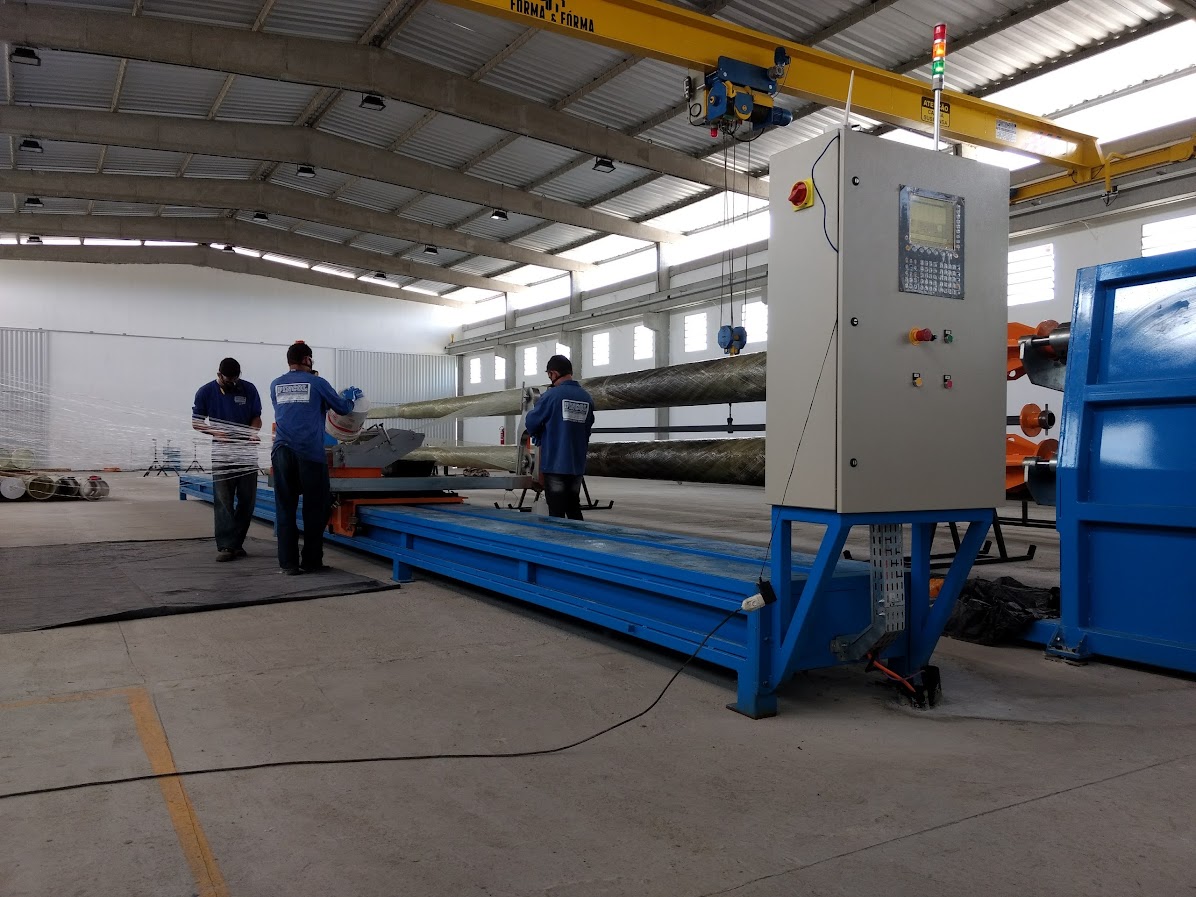
The industrial workflow starts with structural analysis (CAE), defining geometry, fiber orientation and the number of layers. CAM then generates the trajectory and G-code. Impregnated rovings are wound over a tapered mandrel, the part is cured and finally extracted.
Winding angle and machine selection
The deposition angle affects thickness, material consumption and mechanical properties. Machine architecture, number of axes, synchronized speed and tension control determine which trajectories can be executed with stability and repeatability.
Integrated engineering
An efficient line connects structural analysis, trajectory generation, impregnation, winding, curing and extraction. AUMEK engineers the machine and automation around the pole, mandrel, material and required production capacity.